Dhampur Speaks · The ingredient edit
Every sweet
has its sugar.
Khand, bura, misri or shakkar? Get to know the textures, flavours and traditional uses that make each one different — and find the right match for your kitchen.

The difference, in 30 seconds
Crystallised cane sugar. A familiar choice for chai, kheer and halwa.
Different crystal sizes: fine bura for smooth fillings; rock-like misri for a slower dissolve.
Check the regional name and product form. Cane jaggery brings a fuller, molasses-like flavour.
01 / The comparison
Traditional sugars, side by side
Start with texture and flavour. This guide focuses on cane-based versions; names such as jaggery and misri can also cover products made from other sources.
| Sweetener | Texture | Flavour | Use it in |
|---|---|---|---|
| Desi Khand | TextureIrregular crystals; cream to light brown | FlavourSweet with mild cane character | Use it inChai, coffee, kheer, halwa |
| Khandsari | TextureCrystals or powder; product-dependent | FlavourUsually close to Desi Khand | Use it inEveryday sweetening; check grain size |
| Bura / boora | TextureFine grains with a soft texture | FlavourClean sweetness | Use it inGujiya, peda, panjiri, dustings |
| Boora — check the label | TextureThe name alone does not fix the texture | FlavourVaries by product | Use it inMatch the grain to your recipe |
| Misri | TextureLarge, hard rock crystals | FlavourClean sweetness | Use it inWith saunf, prasad; crush if cooking |
| Shakkar | TextureOften loose granules; name varies by region | FlavourCan have a fuller cane flavour | Use it inRustic sweets, depending on the product |
| Cane jaggery / gur | TextureBlocks, cubes or granules | FlavourFuller, molasses-like sweetness | Use it inChikki, til laddoo, gur ki chai |
02 / In your kitchen
Which sugar belongs in your sweet?
Choose a category to see the matching sweeteners. These are ingredient suggestions; follow the method and quantities in your recipe.
03 / A familiar counter
The halwai’s counter that started this article
There is a sweet shop in old Delhi where the man behind the counter keeps five different sugars within arm's reach. Not for show. He simply cannot make what he makes with one of them.
The coarse golden crystals go into the halwa. A fine, almost powdery white sugar gets dusted over the gujiya, because anything larger would sit on the surface like grit. Rock-like crystals on a string go out with the saunf at the end of a meal. A dark, sticky block gets shaved into the winter laddoos. And a bag of plain white sugar sits at the back for the chashni, because chashni wants sweetness and nothing else.
They are all sugar. They are also different ingredients.
Ask him which one is "sugar" and he will look at you strangely. They are all sugar. That is the point. They are also five different ingredients, and swapping one for another is how a good mithai turns into a mediocre one.
Most articles about Indian sweeteners compare exactly two things: sugar and jaggery. That comparison is useful and also badly incomplete, because it leaves out the four or five traditional sugars that Indian kitchens have actually been using all along — and it is the reason so many people cannot tell Desi Khand from bura, or bura from boora, or khandsari from either.
We make these sugars. So this seemed a reasonable thing for us to sort out properly.
04 / The ingredient glossary
Know what is in the bag
Open any ingredient below for its texture, processing and traditional kitchen role.
What is Desi Khand?
Desi Khand is a traditional crystallised cane sugar, generally made by clarifying sugarcane juice, concentrating it into syrup, forming sugar crystals and separating them. The degree of further processing varies by producer and product.
It belongs to the khandsari family, and the names overlap in everyday use. Its crystals can be irregular, and its colour ranges from cream to light brown. The taste is sweet, sometimes with a mild earthy or caramel-like note.
Refining removes colour and other cane components. With less intensive refining, some of those components can remain, influencing flavour and appearance. The product label is more useful than colour alone for understanding a particular pack.
Why isn’t Desi Khand always white?
Residual cane components and the degree of refining can give Desi Khand its creamy, golden or brownish appearance. White sugar looks white because of how light interacts with the mass of purified crystals; brown colour does not by itself establish a nutritional advantage.
This is worth being clear about, because colour is the single most misleading thing on a shelf of traditional sugars. A darker khand is not automatically a better khand. Colour tells you something about processing; it tells you nothing reliable about quality, purity or nutrition. Two producers can make khand of identical quality and different shades. One can also darken a poor product deliberately.
Read the pack and the processing claim. Ignore the shade.
Desi KhandCrystallised cane sugar · everyday cooking
Crystals are allowed to form and are separated from the syrup, but the refining stops well short of white sugar. Irregular crystal, cream to light brown, mild cane warmth. This is the everyday traditional sugar: chai, coffee, kheer, halwa, laddoo.
KhandsariA production category · often overlaps with khand
Khandsari refers to sugar made from cane juice by an open-pan process. FSSAI recognises it as a distinct sugar category, with desi and sulphur varieties; it can be crystalline or powdered. Desi Khand is commonly used as a market name within this family, so check the particular product rather than relying on the name alone.
BuraFine-grained sugar · smooth fillings and coatings
Bura is a fine-grained sugar. In a traditional preparation, sugar is dissolved in water and the concentrated syrup is worked as it cools to form a fine, soft texture. Its texture is the useful distinction in the kitchen; methods and grain size can vary.
Use it where larger crystals would be noticeable: gujiya filling, peda, panjiri or sweet dustings. Check that the sugar is fine enough for the texture you want.
BooraA familiar spelling · check the grain size
Bura and boora are commonly used as variant spellings. Regional and trade usage can be inconsistent, so a name alone is not a reliable description of grain size. Inspect the product texture and follow the recipe’s wording.
A filling or dusting usually needs fine sugar. If your recipe specifies a coarser traditional sugar, check the pack’s description rather than assuming every product labelled boora will behave the same way.
MisriRock sugar · larger, slower-dissolving crystals
Misri, or rock sugar, is made by dissolving sugar into a syrup and letting it recrystallise very slowly, often around a thread, over days. Slow growth produces few, very large crystals instead of many small ones.
Large pieces dissolve more slowly than smaller crystals under similar conditions. Misri is familiar with saunf and in prasad; it can also be used in cooking when crushed or given enough time to dissolve.
Shakkar & jaggeryGranules, blocks and regional names
Cane jaggery is concentrated cane juice made without separating the sugar crystals in the way used for crystallised sugar. It is often called a non-centrifugal sugar; that does not mean it contains no sugar crystals. Clarification and heating still change the juice.
Jaggery is sold in blocks, cubes and granular forms. In some kitchens, shakkar describes a loose granular cane sweetener, while elsewhere it simply means sugar. These products can bring a stronger cane or molasses-like flavour to chikki, gur ka halwa, winter laddoos and gur ki chai. Read the label to identify the form you are buying.
Khandsari and Desi Khand: is there a difference?
The words often overlap in everyday use, but the product and process matter more than the name.
Khandsari has a defined place in Indian food standards: it is obtained from sugarcane juice by an open-pan process. Desi Khand is a familiar name used in the marketplace. Compare the ingredients, texture and processing information on the specific pack.
What matters more than either word is what a specific pack tells you. "Traditionally processed", "sulphurless", "unrefined" and "organic" are four separate claims about four separate things, and a product can carry one without carrying the others.
What does sulphurless actually mean?
Sulphur dioxide is used in conventional sugar processing as a clarifying and bleaching agent — it strips colour and helps produce a whiter crystal. A sulphurless sugar is made without that step.
“Sulphurless” describes the omission of that processing step. It does not, by itself, prove zero residues, a particular colour or a health advantage. Those are separate claims that need their own evidence.
Why are these names so confusing?
Three reasons, and they compound.
The first is regional. India did not standardise its sweetener vocabulary, and the same word travels differently across states. Bura in Delhi is not always boora in Lucknow, and shakkar means loose granular sugar in one kitchen and plain sugar generally in another.
The second is that packaging has outrun the vocabulary. These sugars were bought loose, by sight, from someone who knew what you were making. You pointed. Nobody needed a category name. Now the same product arrives in a printed pouch that has to declare what it is in one or two words, and those words were never precise to begin with.
The third is marketing. Words such as “natural”, “traditional”, “pure”, “desi” and “unrefined” can suggest a story without fully explaining a product. Read the ingredients, processing description and certification details rather than treating these words as interchangeable guarantees.
05 / Read the label
Five checks before you buy
Use these checks on the pack or product page. “Sulphurless”, “organic” and “khandsari” describe different aspects of a product.
- Read the ingredients and product identity.Confirm whether you are buying khand, brown sugar or jaggery powder. If the description is unclear, ask the seller for clarification.
- Treat each processing claim separately.Sulphurless, organic, unrefined and khandsari are four different statements. A product may be one and not the others.
- For organic, look for certification details.Check the certifier and the product’s certification information. The word “natural” is not a substitute for organic certification.
- Check who made it.Manufacturer or marketer name, FSSAI licence number, net quantity, packing date. A food business willing to be identified is telling you something.
- Compare per kilo, not per pack.Pouches, jars and sachets carry different packaging costs. Work out the rate per kilo and choose the format that matches how fast your kitchen actually gets through it.
Is khand healthier than white sugar?
Desi Khand is sugar. Less refining does not change that, and we are not going to tell you otherwise.
Flavour, texture and performance in traditional cooking are useful reasons to choose khand. Less refining alone does not establish a meaningful health advantage.
If you are managing diabetes: Desi Khand is a sugar-containing sweetener and can affect blood glucose. Follow the eating plan agreed with your doctor or qualified dietitian. Read NIDDK’s guidance.
The amount used matters as well as the variety. If you want less sugar in everyday drinks, reduce it gradually and adjust to taste.
Keep your khand dry.
Good storage helps preserve its texture.
- Follow the storage directions and date information on the pack.
- Use a clean, airtight container and a dry spoon.
- Keep it away from steam, the stove and damp surfaces.
- Check clumped sugar for its overall condition; discard it if contaminated.
06 / The Dhampur Green range
Find your everyday favourite
Choose the variety for your cooking and processing preferences.
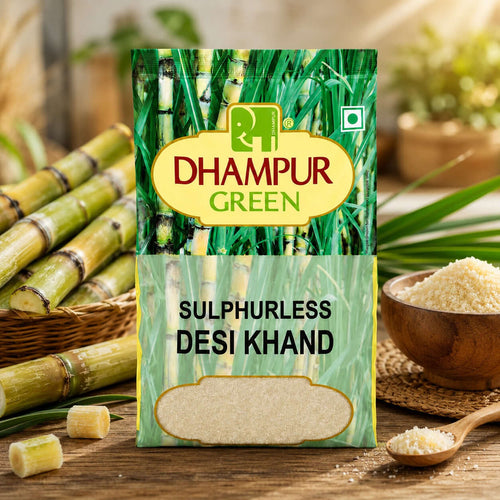
For everyday chai
Sulphurless Desi Khand
A mild choice for tea, coffee, kheer and daily cooking.
View Sulphurless Khand →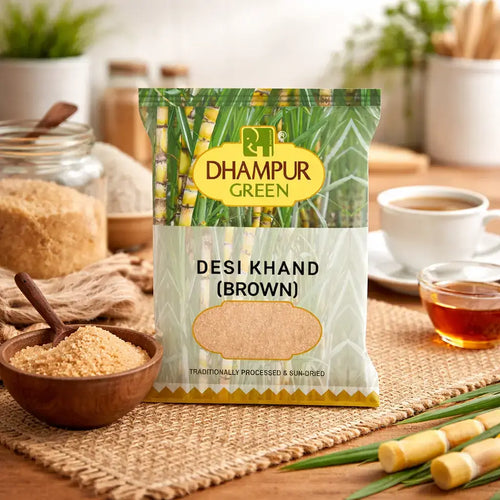
For fuller cane flavour
Brown Desi Khand
Try it in halwa and other dishes where a warmer cane character fits.
View Brown Khand →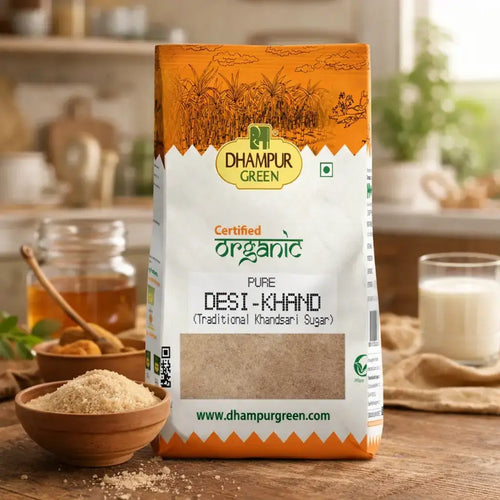
For an organic pantry
Organic Pure Desi Khand
Explore the organic option and check the pack’s certification details.
View Organic Khand →Single-serve sachets can make portioning more convenient.
Check each product page for current pack sizes, prices and availability. Looking for gur? Browse the jaggery collection.
Back to contents ↑07 / Your questions
A few good questions
Tap a question to read the answer.
What is Desi Khand in simple words?
Desi Khand is traditional crystallised cane sugar, commonly associated with khandsari. Colour, grain size and flavour vary with the product and its processing.
Is Desi Khand the same as khandsari?
The names often overlap. Khandsari specifically refers to sugar obtained from cane juice by an open-pan process; check the label to understand the particular Desi Khand product.
What is the difference between Desi Khand and bura?
Khand is usually sold with a noticeable crystal texture. Bura is finer-grained and useful where you want a smoother filling or coating. Check the actual grain size because products vary.
Is bura the same as boora?
Often, yes: the words are used as variant spellings. Regional and trade usage may differ. Choose the product by its texture and your recipe’s requirements.
What is the difference between Desi Khand and misri?
Misri is rock sugar with larger crystals; Khand usually has smaller crystals. Large pieces of misri dissolve more slowly under comparable conditions, though crushing them changes that.
Is Desi Khand the same as brown sugar?
Not necessarily. Brown sugar contains molasses with its sugar crystals and may be produced in different ways, including adding molasses to refined sugar. Desi Khand is associated with khandsari-style processing. Similar colour does not guarantee the same texture or recipe result.
Does darker Desi Khand mean better quality?
No. Colour reflects how much refining and bleaching the sugar went through, not its quality or purity. Two khands of equal quality can differ in shade, and colour can be manipulated. Check the ingredient line and processing claims instead.
What does sulphurless Desi Khand mean?
It means sulphur dioxide was not used in the claimed processing step. It does not automatically establish zero residues, organic status or a special health benefit.
Can Desi Khand replace white sugar in any recipe?
It can work in many drinks and everyday dishes, adjusting to taste. For baking, follow recipe weights and test a small batch: crystal size and moisture can affect mixing, texture, spread and browning.
Does Desi Khand contain minerals that white sugar does not?
Less-refined cane products may retain small quantities of minerals, but amounts vary. A processing description alone is not evidence that a product is a meaningful mineral source. Check substantiated nutrition information.
Is khandsari officially different from ordinary sugar in India?
Yes. FSSAI defines khandsari sugar separately from plantation white and refined sugar, using the open-pan process as part of its definition.
08 / One last thought
Back to the counter
The halwai with five sugars is not being fussy. He is doing something most of us stopped doing when a single white sugar took over the shelf: choosing the sweetener to suit the dish.
You do not need five. But knowing that khand, bura, misri and gur are four genuinely different ingredients — and not four words for the same bag — changes how a kitchen cooks. The laddoo comes out right. The gujiya filling is smooth. The chai tastes like it did at someone's grandmother's house, and you finally know why.
That knowledge used to be passed across a counter. Now it mostly has to be looked up. We would rather it came from someone who makes the stuff.
Start with one familiar recipe.
A cup of chai. A pan of halwa. A batch of laddoos. Choose the sweetener for the texture and flavour you want.
Read our full Desi Khand buying guide →Sources & further reading
These links support specific definitions and general health context. They do not independently verify every product claim or kitchen suggestion in this article.
- FSSAI: sweetening agents standards (PDF) — definitions for sugar, khandsari, bura, misri and cane jaggery. See sections 2.8.1, 2.8.2 and 2.8.4.
- NIDDK: healthy living with diabetes — individual eating plans and managing blood glucose.
- Dhampur Green’s Desi Khand buying guide — related product and kitchen information from the brand.